
The Top 10 HubSpot Alternatives for 2026

If your business has outgrown HubSpot - or the pricing has started to sting - you are not alone. HubSpot is a powerful platform, but it bundles a lot of features most small teams never touch, and the cost reflects that. Whether you are looking for a cleaner shared inbox, better email collaboration, or simply a tool that fits your actual workflow, there are excellent alternatives out there.
This guide walks through the top 10 HubSpot alternatives for 2026, covering shared inbox tools, CRM platforms, and customer support software, so you can find the right fit for your team.
Why Teams Look for HubSpot Alternatives
HubSpot started as a marketing tool and grew into a full CRM suite. That growth brought real power, but also real complexity. Here is what teams typically cite when they start shopping around:
- Cost: Free tiers are limited, and paid plans scale quickly into hundreds or thousands of dollars per month.
- Complexity: Teams that just need email collaboration do not need a full CRM with pipelines, sequences, and automation rules.
- Contact limits: Many plans cap the number of contacts, which creates friction as you grow.
- Overkill for support teams: If your primary need is managing a shared support inbox, HubSpot is often more than you need.
The good news: the market for team email and customer support software has matured significantly. Let us look at the best options.
1. Helpmonks - Best Shared Inbox for Growing Teams
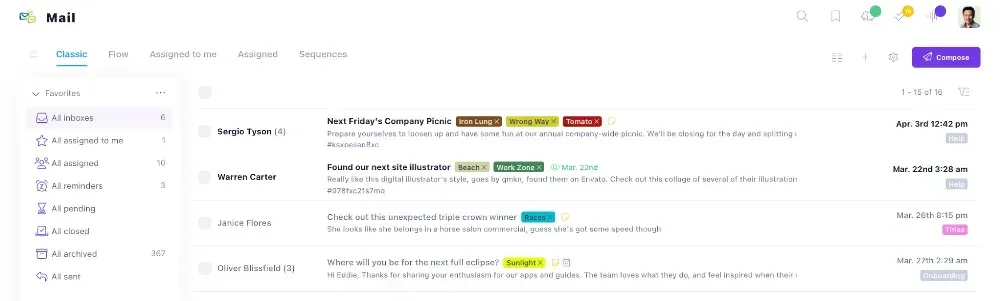
Helpmonks is built specifically for teams that live in email. Instead of bolting inbox management onto a CRM, Helpmonks starts with the inbox and builds everything else around it. You get a true shared inbox where every team member can see, assign, and reply to messages without forwarding chains or BCC confusion.
Key features include collision detection (so two agents never reply to the same email simultaneously), internal notes, smart rules for automation, and a CRM layer that tracks contact history without requiring you to manage a pipeline. Unlike HubSpot, Helpmonks does not charge by contact count. Instead, you pay per mailbox, which makes costs predictable as you scale.
Best for: Support teams, small businesses, agencies managing client communications.
2. Freshdesk - Best for Multi-Channel Support
Freshdesk is one of the most widely used HubSpot alternatives for customer support teams. It offers a ticketing system, live chat, phone support, and social media integration in one platform. The free plan is genuinely useful for small teams, and the paid tiers add automation, analytics, and AI-powered features.
Where Freshdesk excels is multi-channel routing - bringing email, chat, and phone into a single queue. Where it falls short, for some teams, is the ticket-centric model. Not every customer interaction needs to be a ticket, and the UX can feel formal for teams used to email.
Best for: Mid-size support teams needing multi-channel coverage.
3. Zoho CRM - Best Budget CRM Alternative
If what you actually need from HubSpot is the CRM - contact management, pipeline tracking, deal stages - Zoho CRM delivers most of that functionality at a fraction of the price. It integrates with the broader Zoho ecosystem, including Zoho Desk for support and Zoho Mail for team email.
The trade-off is UX. Zoho has historically felt dated compared to HubSpot, though recent updates have improved things. The value proposition is strong if you are willing to invest time in setup.
Best for: Small businesses wanting a full CRM on a tight budget.
4. Front - Best for Teams That Live in Email
Front turns your email into a collaborative workspace. It looks and feels like a standard email client but adds shared inboxes, internal comments, assignments, and workflow automation underneath. Teams that find help desk ticketing systems too rigid often gravitate toward Front.
The main downside is pricing: Front starts at around $19 per seat per month, and costs add up quickly for larger teams. For smaller teams, Helpmonks often offers a more cost-effective path to the same shared inbox experience. You can read more about how shared inbox tools compare on the Helpmonks blog.
Best for: Teams wanting email-native collaboration without a ticket queue.
5. Intercom - Best for Product-Led Growth Teams
Intercom started as a customer messaging platform and has evolved into a full support and engagement suite. It shines for SaaS companies that want to integrate live chat, product tours, and email sequences into a single workflow. The AI features, including its Fin chatbot, are among the most mature in the market.
Intercom is not cheap. Pricing can run $200-$400+ per month for growing teams, which is why it appears on so many 'too expensive' lists alongside HubSpot. But if you need in-app messaging, onboarding flows, and support in one place, it is hard to beat.
Best for: SaaS companies focused on user engagement and retention.

6. Pipedrive - Best Sales-Focused CRM
If your primary use case is sales pipeline management rather than support or marketing, Pipedrive is worth a serious look. It is opinionated about one thing: moving deals through a pipeline. The visual board is intuitive, the mobile app is strong, and the integrations cover most common sales tools.
Pipedrive does not try to be a marketing platform or a full support suite. That focus is its strength. Teams that got lost in HubSpot's breadth often find Pipedrive refreshingly direct.
Best for: Sales-driven teams that want pipeline clarity without the noise.
7. Help Scout - Best for Customer-First Support Teams
Help Scout is built around the idea that support should feel personal, not transactional. Customers receive replies that look like normal emails, not ticket confirmations. Internally, the team has full visibility, collision detection, and threaded notes.
It also includes Docs, a knowledge base tool, and Beacon, an embeddable widget for in-app help. The pricing is reasonable and the UX is clean. It is a strong alternative for support-focused teams that want something lighter than Zendesk but more structured than a shared Gmail account.
Best for: Small to mid-size support teams that prioritize a human touch.
8. ActiveCampaign - Best for Email Marketing Automation
If you are primarily using HubSpot for email marketing and automation sequences, ActiveCampaign is the most capable direct replacement. Its automation builder is visual, flexible, and genuinely powerful - handling complex branching logic that would require a higher HubSpot tier.
It also includes a lightweight CRM and SMS capabilities. The learning curve is real, but teams that invest in the setup tend to see strong results. For pure marketing automation at a lower price point, it is one of the best options on the market.
Best for: Marketing teams with complex automation needs.
9. Zendesk - Best for Enterprise Support Operations
Zendesk is the name most people think of when they hear 'customer support software.' It handles high ticket volumes with advanced routing, SLA management, and reporting that scales to enterprise requirements. The integration marketplace is enormous.
The caveat: Zendesk is not small-team friendly. Pricing starts around $55 per agent per month for meaningful features, and the configuration overhead can be significant. Teams that are replacing HubSpot because it felt heavy may find Zendesk equally heavy in a different direction.
Best for: Enterprise teams with dedicated support operations.
10. Groove - Best Simple HubSpot Alternative
Groove is a straightforward shared inbox and help desk tool that gets out of your way. There is no bloat, no unnecessary configuration, and no feature that requires reading a help article before you can use it. The shared inbox, knowledge base, and reporting cover the essentials cleanly.
It has grown its feature set in recent years while maintaining simplicity. For teams that have been burned by tools that started simple and became complex, Groove is worth evaluating.
Best for: Small teams wanting a no-frills support inbox.
How to Choose the Right HubSpot Alternative
The right choice depends on what you were actually using HubSpot for. Here is a quick decision framework:
- Shared inbox and team email collaboration: Helpmonks, Front, or Help Scout
- CRM and deal pipeline: Pipedrive or Zoho CRM
- Email marketing and automation: ActiveCampaign
- Multi-channel customer support: Freshdesk or Zendesk
- SaaS product engagement: Intercom
If your team is primarily managing email - support requests, sales inquiries, or client communication - a dedicated shared inbox tool will serve you better than a CRM that happens to include email. Helpmonks is worth a close look in that category.
Final Thoughts
HubSpot is a great product for the teams it was designed for. But that does not mean it is the right fit for every team. The alternatives above cover a wide range of use cases - from lean shared inboxes to full enterprise support suites - and most offer free trials that let you test before committing.
Start by identifying your primary use case - email collaboration, pipeline management, or support automation - and work backward from there. The best tool is the one your team will actually use.
Ready to try a shared inbox that puts email first? Take a look at what Helpmonks offers and see if it fits your workflow.